
The Drama Triangle: Victim, Persecutor, Rescuer, and How to Step Out
You call your mom to mention one small thing, and twenty minutes later you are apologizing for something you never did. You both hang up feeling misunderstood, and neither of you is quite sure how it happened. If your family conversations keep going in circles like this, the drama triangle can help explain why.
The drama triangle is not my idea. Psychiatrist Stephen Karpman described it in 1968, and it has become one of the most useful maps I know for what happens when a relationship gets stuck. It comes up with my clients most often around family, and when it does, I usually draw it for them right there in session. Here is that drawing, and what it shows.
What Is the Drama Triangle?
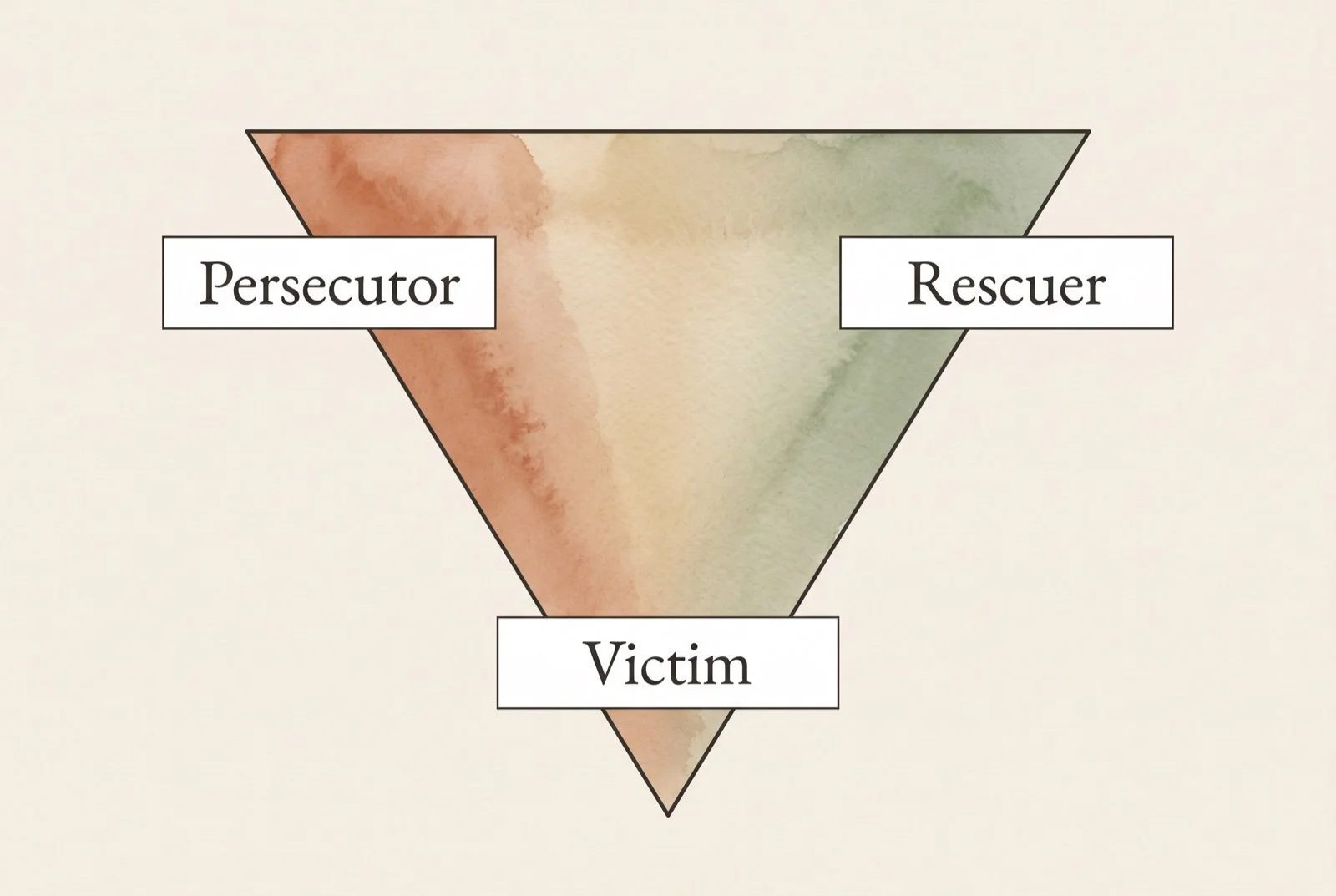
The Karpman drama triangle starts from a simple idea: in our relationships, we are always trying to get our needs met in some way through the other person. When a relationship is working, that happens in ways that feel mutual. When there is some dysfunction, we keep trying to get our needs met in ways that are not really working, and we slip into one of three roles: the victim, the persecutor, or the rescuer.
The roles are not personality types. They are positions we take in a moment, and most of us move between all three, sometimes within a single conversation. The triangle shows up in dating, friendships and at work too, but it is especially sticky in families, where the roles were often set long before any of us had words for them.
The Three Roles: Victim, Persecutor, Rescuer
The Rescuer
The rescuer steps in to fix, advise or solve, often before anyone has asked. There is usually real care underneath, and often a need to feel useful or needed. The trouble is that rescuing tells the other person, without saying so, that they cannot manage on their own.
The Persecutor
The persecutor blames, criticizes or pushes back. It is easy to picture this role as the villain, but you do not have to be harsh to be cast in it. Sometimes all it takes is saying no to a rescuer who was trying to help.
The Victim
The victim feels hurt, helpless, or like nothing they do is ever right. This is a role, not a judgment. It does not mean the person has not been genuinely hurt, and it is not the same as being the victim of something real. It describes a stance in the moment: I cannot fix this, and it is happening to me.
| The role | What it sounds like | What it is reaching for | What gets lost |
|---|---|---|---|
| Rescuer | "I'm only trying to help." | To feel needed, and to make the discomfort stop | The other person's chance to handle it themselves |
| Persecutor | "This is your fault." or "Stop telling me what to do." | Control, or some space that feels safe | Connection, and often the point you were trying to make |
| Victim | "I can't do anything right." | Comfort, reassurance, being taken care of | A sense of your own agency |
A Drama Triangle Example: The Setup
Here is an example I use with clients, because so many of them recognize it. Say you have a close but conflicted relationship with your mom. She is not the best listener, but she loves to give advice, and in her heart she wants to be a good mom and to help. You, meanwhile, are an adult who wants to run your own life.
One day she brings up your dating life. She met a woman at her community club whose son sounds wonderful, and she thinks the two of you should go on a date. You do not want your mom to set you up. Here is how the triangle plays out:
Mom starts as the rescuer. She is trying to solve a problem she sees, your being single, because she is worried you will not be happy.
Your no puts you in the persecutor role. You say, reasonably, that you do not want to be set up. To her, it lands as rejection.
Mom moves to victim. She gets defensive and hurt: "I was just trying to help. I'm a terrible mother. I can't do anything right."
Guilt pulls you into rescuer. Now you are the one soothing: "No, Mom, you're a good mom. Fine, give him my number."
In one short conversation, you have each been in two roles, and nobody got what they needed. Your mom still feels unappreciated. You have a date you never wanted. And the next time the topic comes up, it will be even harder to say what you actually think.
That is what makes the drama triangle so sticky. Being in it keeps one or both people feeling that their needs are not being met, and once you are in it, it is hard to break out.
The Drama Triangle in Families
Families are where the triangle gets the most practice. The roles often go back decades, and everyone knows their lines. When my clients describe it, what they usually describe is not a single fight but a feeling: that they cannot fully be themselves or say what they want to say, because they are worried about the reaction, or that it will just turn into a bigger problem.
Culture can add another layer. For many of my Asian American clients, especially first-generation Americans, there is a different set of expectations around parents, respect and duty, and saying what you want can feel like breaking a rule nobody ever said out loud. None of that makes you or your parents the bad guy. It makes the triangle easier to fall into.
The Drama Triangle and Codependency
If you land in the rescuer role in most of your relationships, not just with your parents, that pattern has a lot in common with codependency: your sense of being okay depends on keeping everyone else okay. I wrote more about that in high-functioning codependency, and it is a big part of my codependency work. The care that keeps you in the rescuer role is a real strength. The work is pointing some of it back toward you.
How to Get Out of the Drama Triangle
Getting out does not start with finding the perfect thing to say. It starts with seeing the triangle while you are in it. Here is how I work through it with clients.
Notice Where You Are
The first step is simply noticing: which role am I in right now, and which one is the other person in? You do not have to change anything yet. Naming the role in the moment, even silently, creates a little space between you and the pattern.
Find Your Usual Corner
Most of us have a corner we return to. Ask yourself where you most often get stuck. It can be uncomfortable to realize that we participate in the triangle too, that it is not only the other person, but this is where the hope is. If you notice that you are always the rescuer, you can also see that you have a choice about staying there.
Get Creative About Your Next Move
Once you know your corner, you can get creative about what you might do differently. In the setup example, that could sound like: "I know you want me to be happy, and I love that about you. I'm not looking to be set up right now." Then comes the hard part, which is not rushing in to rescue when the guilt arrives.
This is where the drama triangle and boundaries meet. A boundary is how you hold your ground without moving into the persecutor role, and without abandoning yourself in the rescuer one. If that is where you are, my guide on how to set boundaries with parents walks through it step by step.
Plan for the Pull Back
Expect the old pattern to pull at you, especially the first few times. It helps to decide in advance what you will say and do when it happens, a DBT skill called coping ahead. The goal is not a perfect conversation. It is a slightly different one, and then another.
Drama Triangle vs Empowerment Triangle
You may also come across the empowerment triangle, a reframe from author David Emerald. It keeps the shape but changes the roles: the victim becomes a creator, focused on what they want rather than what is happening to them; the persecutor becomes a challenger, who pushes for growth without blame; and the rescuer becomes a coach, who supports without taking over.
Seen side by side, the drama triangle and empowerment triangle describe the same relationship before and after something shifts. The new roles are a helpful picture of where you are heading, though the noticing usually has to come first. It is hard to step into a new role before you can see the old one.
Common Questions About the Drama Triangle
What are the three roles in the drama triangle? The victim, the persecutor and the rescuer. Psychiatrist Stephen Karpman, who described the model in 1968, drew them as the three points of a triangle to show how people move between them when a relationship gets stuck, which is why it is often called Karpman's drama triangle.
Can you be in more than one role at a time? You can move between all three, often within a single conversation. That movement is what keeps the triangle going: each shift pulls the other person into a new role in response.
Is the drama triangle the same as codependency? No, but they overlap. Someone who habitually takes the rescuer role, and who feels okay only when everyone else is okay, is often dealing with a codependent pattern. The triangle describes the interaction; codependency describes the pattern underneath it.
How does therapy help with the drama triangle? Therapy gives you a place to slow the interaction down, map where you tend to land, and practice a different response before you try it with your family. For many people it also means understanding where the pattern started, which makes it easier to change.
You Do Not Have to Stay Stuck
If you keep ending up in the same conversation with your family, it is not because you are doing it wrong. It is because the triangle is doing what it does. In my NYC practice I work with adults navigating family patterns, codependency and bicultural identity, and a lot of that work starts with a drawing of three points on a page.
The most difficult step in the healing process is often the very first one, reaching out. If you are ready, I offer a free 15-minute consultation. I'm glad you reached me. I'm here to help.