
Sand Tray Therapy for Adults: What Sandplay Is and Why It Works
Sand tray therapy for adults tends to raise an eyebrow. A tray of sand, shelves of small figures, and an invitation to build something without explaining why. It sounds like something for children, and most adults in New York are fairly sure they have outgrown play.
Sandplay is a form of expressive therapy where you arrange miniature objects in a tray of sand to make a scene, and then we look at it together. There is no right way to build and nothing you have to justify. With adults it works alongside talk therapy, not instead of it, and it tends to reach the things that talking circles around.
This article is about the why: why building a small world in sand can move something that hours of conversation have not, and what it is actually like from the chair. For the practical side, my sandplay therapy page covers sessions, fees and how it fits with EMDR.
What Is Sandplay Therapy for Adults?
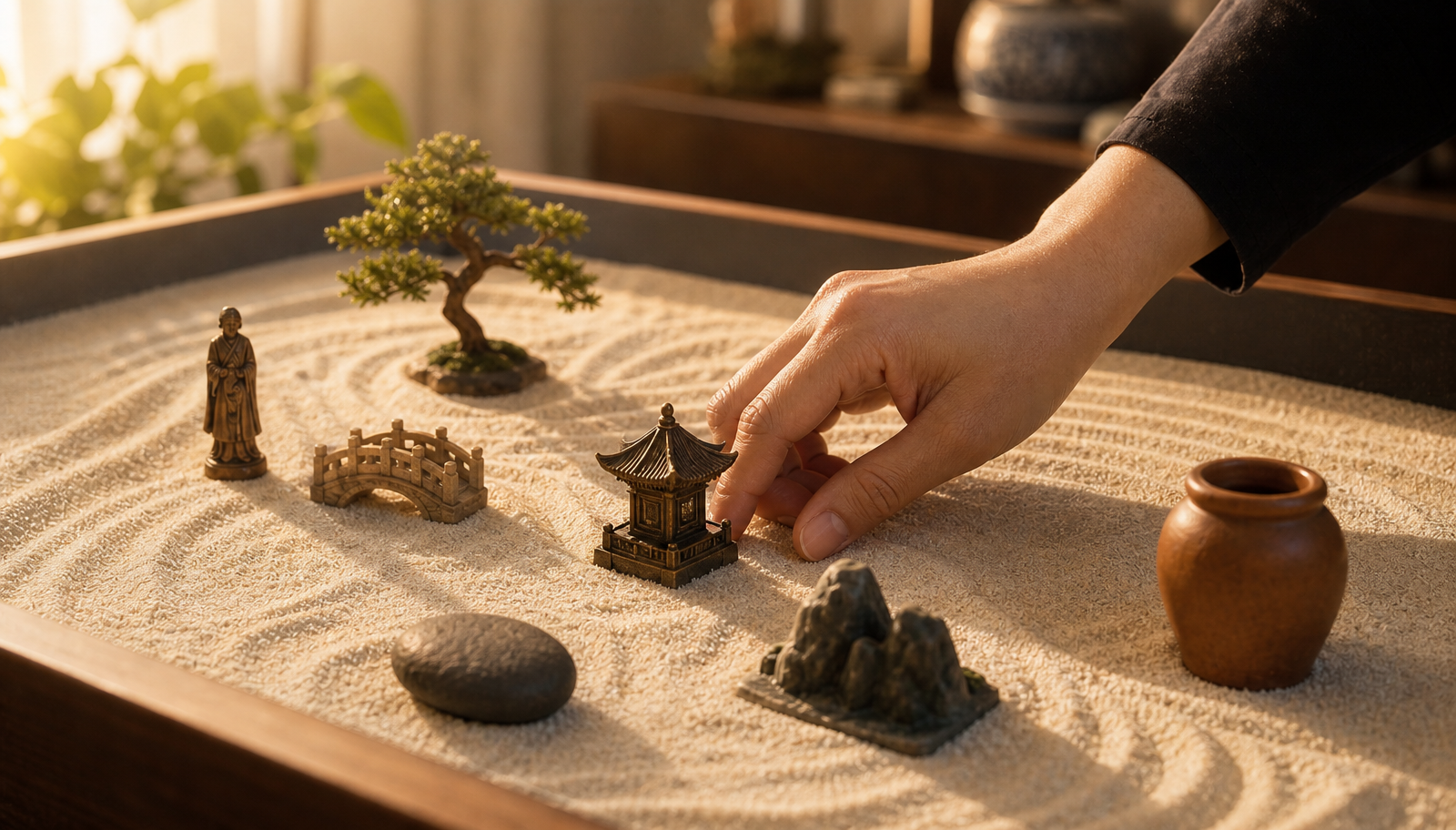
Sandplay therapy for adults is the same method used with children, taken seriously as adult work. You choose figures, objects and materials from a collection, place them in a tray of sand in any way you like, and then we spend time with what you made. The tray is a world you get to build without the pressure of doing it right.
I use it inside a trauma-informed practice, alongside talk therapy and EMDR, and I offer it to adults who have never touched a sand tray as readily as to people who have done it before.
Why Talking Only Gets You So Far
Talk therapy is the majority of what I do, and it works. But for a lot of people it eventually hits a ceiling, and the ceiling is the head.
Many of the people I see in New York are working professionals, and many of them are high achievers. Thinking is what they are good at. It is also a very comfortable and safe place to stay: you can think in circles about a problem for years, understand it thoroughly, and never quite feel it or change it. Talking about something is not always the same as touching it.
Sandplay takes the pressure off words. Instead of explaining, you make. Instead of analysing why you feel a certain way, you notice what you reach for. It invites the parts of you that do not speak in sentences, and for people who live in their heads, that is often where the movement has been waiting.
What Happens in a Sandplay Session
A sandplay session is quieter than most people expect. Here is the shape of it:
You look at the shelves. Miniatures of people, animals, buildings, trees, stones, vehicles, doors, bridges, fragments of things. There are hundreds and none of them mean anything in particular.
You pick what pulls you. I encourage people not to think too hard about why. Some people, especially those who have done it before, arrive with a theme in mind, say their relationship to their job. Most do not, and that is fine. Trust your gut about what you gravitate toward.
You build. You arrange what you chose in the sand however you like. I stay quiet and out of the way. There is no clock on this part.
We look at it together. You say as much or as little as you want. I might ask what it was like to make, or what you notice now that it is in front of you.
What came up becomes the therapy. Sometimes it is obvious. Often it is something you did not know you were carrying, and that is where the work goes next.
Nobody is graded and nobody is interpreted at. If you want to build a beach and leave it at that, you can.
Sand Tray Therapy Examples: What Tends to Come Up
The reason sandplay works is that what you pick tends to be connected to something real, even when you cannot say why in the moment. Here is an example from my own training.
I once built a tray and put a door in it. I did not know why. I just wanted a door, standing open, looking out onto the rest of the scene, and I thought it looked good there. As we processed the tray it turned out to be about stepping into a new beginning, a new phase that was actually happening in my life at the time and that I had not been consciously thinking about at all. The tray knew before I did.
That is the typical shape of it. A choice made on instinct turns out to be carrying something, often a memory that is old but significant. Some patterns I see often, blended so that no one is recognisable:
A carefully fenced area with everything neat inside it, and one small figure placed outside the fence. The conversation that follows is usually about belonging, or about who had to stay out.
A scene where every figure faces away from the centre. Often the first time someone has been able to show, rather than say, how alone a full life can feel.
A bridge that connects two very different landscapes, a city on one side and something older on the other. For clients navigating two cultures, this one comes up in many forms.
A tray built almost entirely of natural objects, stones and shells and wood, by someone whose days are all screens and deadlines. The absence is the point.
None of these have fixed meanings. The same bridge means something different for every person who builds one, and it is your reading of it that counts.
Who Gets the Most from Sandplay
Sandplay helps people who cannot easily get out of their own heads, and it tends to be a relief for people who have very little room for play in their lives. A few groups come up again and again:
People who live in their heads. Analytical, articulate, insightful, and stuck. The tray offers a route that does not go through argument.
People with no space for play. If your days are entirely work and obligation, sandplay can be a way of reconnecting with the part of you that used to build things for the sake of it. That reconnection is often therapeutic in itself.
Creative people. Designers, artists, writers, musicians tend to take to sandplay quickly, because expressing themselves visually is already comfortable. The tray gives that existing skill somewhere new to go.
People who do not have the words yet. Sometimes you know something is wrong and cannot say what. Building lets you show it first.
People doing trauma work. Sandplay pairs well with EMDR as somewhere to land after heavier processing, and as a second language for the same material.
People holding more than one identity. For my clients who are Asian American, biracial or adopted, the tray is one of the few places where two worlds can sit side by side without anyone asking you to choose.
Sandplay vs Talk Therapy: What Changes
Sandplay does not replace talking. Most of my clients do both, sometimes in the same session. But the two ways of working ask different things of you and produce different kinds of movement:
| Talk therapy | Sandplay | |
|---|---|---|
| Where the work happens | In language and thought | In images, objects and the body first; words come after |
| What you need to bring | Something to say | Nothing. Curiosity helps |
| Pace | Follows the conversation | Slower, quieter; a scene takes twenty or thirty minutes to build |
| What progress looks like | Insight, new understanding | Something you did not know you were carrying, now visible in front of you |
| When it helps most | Sorting through a decision, a relationship, a week | When you have talked it through many times and it still has not moved |
| Who leads | You and I, in dialogue | You build; I watch and hold the space, and we look together at the end |
Is Sand Tray Therapy Evidence-Based?
Sandplay has a long clinical history and a growing research base. It grew out of Margaret Lowenfeld's work with children in the 1920s and 1930s and Dora Kalff's development of sandplay in the 1950s, and it has been studied most with children and, more recently, with adults and with trauma.
I want to be honest about what that means. The evidence for sandplay on its own is not as extensive as the evidence for EMDR or for cognitive and behavioural approaches, and I do not use it as a standalone treatment for PTSD. I use it inside a trauma-informed practice, alongside talk therapy and EMDR, because in my experience it reaches material that those approaches can leave untouched. That is a clinical judgement, and it is one I am glad to talk through with you.
Do You Interpret My Tray?
Not in the sense of telling you what it means. There are no secret meanings for a lighthouse or a snake that I decode while you are not looking. The meaning is yours, and my job is to be curious with you rather than to read your mind.
What I will do is notice. Where you hesitated, what you moved, what you almost put in and did not. I might name a pattern I have seen before and ask whether it fits. If it does not, it does not. Nobody is diagnosed from a sand tray, and nobody is told what they feel.
Frequently Asked Questions
How is sandplay different from art therapy?
They are cousins. Art therapy usually asks you to make something from scratch, with paint, clay or pencil. Sandplay gives you a set of ready-made objects and a tray, so there is nothing to be good at and no blank page. For a lot of adults that lowers the bar enough to begin.
What if I feel silly doing it?
Most people do, for about five minutes. Then they get absorbed. Feeling silly is usually the adult part of you protecting the part that wants to play, and that is worth noticing in itself. You can stop at any point and just talk.
How often would we do sandplay?
It varies. Some clients build a tray every few weeks; some do it once and never again; some use it whenever talking gets stuck. It is one option in the room, not a programme. We decide together each time.
Can sandplay help with trauma?
Yes, as part of a wider approach. Sandplay gives traumatic material a place to be expressed without words, which many people find more tolerable than talking. I pair it with EMDR and talk therapy rather than relying on it alone.
What do the figures mean?
Whatever they mean to you. The same figure means different things to different people, and different things to the same person on different days. I do not work from a dictionary of symbols, and I would be wary of anyone who does.
Do I need to talk about what I built?
No. Some people talk through every object. Some sit with the tray in silence and say a sentence at the end. Some photograph it and take it home to think about. All of that counts.
A Different Way In
If you have talked something through a hundred times and it has not moved, that is not a failure of effort. It may just be that the thing does not live in language. Sandplay is a way of finding out, and it is gentler than it sounds.
Reaching out is the hardest step. I'm glad you found your way here.