
Most of the people I work with are very smart. They have insight. They can sit across from me and say, "I know I'm catastrophizing. I know it doesn't make sense." And still, the fear doesn't move. Telling someone who is in the middle of a big emotion to just look at the logic rarely helps.
That's where wise mind comes in. It's one of the first skills I teach when someone starts DBT, and one I come back to again and again, especially with clients who tend toward black-and-white thinking. I used it with a client just recently.
This is wise mind the way I explain it in session: what it is, the three states of mind it comes from, the example I use most, and a simple worksheet you can try on your own.

What Is Wise Mind?
Wise mind is a mindfulness skill from dialectical behavior therapy (DBT). It's the place where your emotional mind and your logical mind overlap, and where both are treated as having value and truth.
I didn't invent this. Wise mind comes from psychologist Marsha Linehan, who developed DBT, and it draws on DBT's roots in Buddhist philosophy, especially the idea of the middle path. Instead of asking which side of you is right, wise mind asks how both can be true at the same time.
That matters because so many people who benefit from DBT get pulled into all-or-nothing thinking. Either I listen to my fear, or I ignore it. Either my feelings are right, or the facts are. Wise mind says you don't have to choose.
The Three States of Mind in DBT
DBT describes three states of mind, and most of us move between all three in a single day. Most wise mind DBT handouts show them as a Venn diagram: emotional mind on one side, reasonable mind on the other, and wise mind where the two circles overlap.
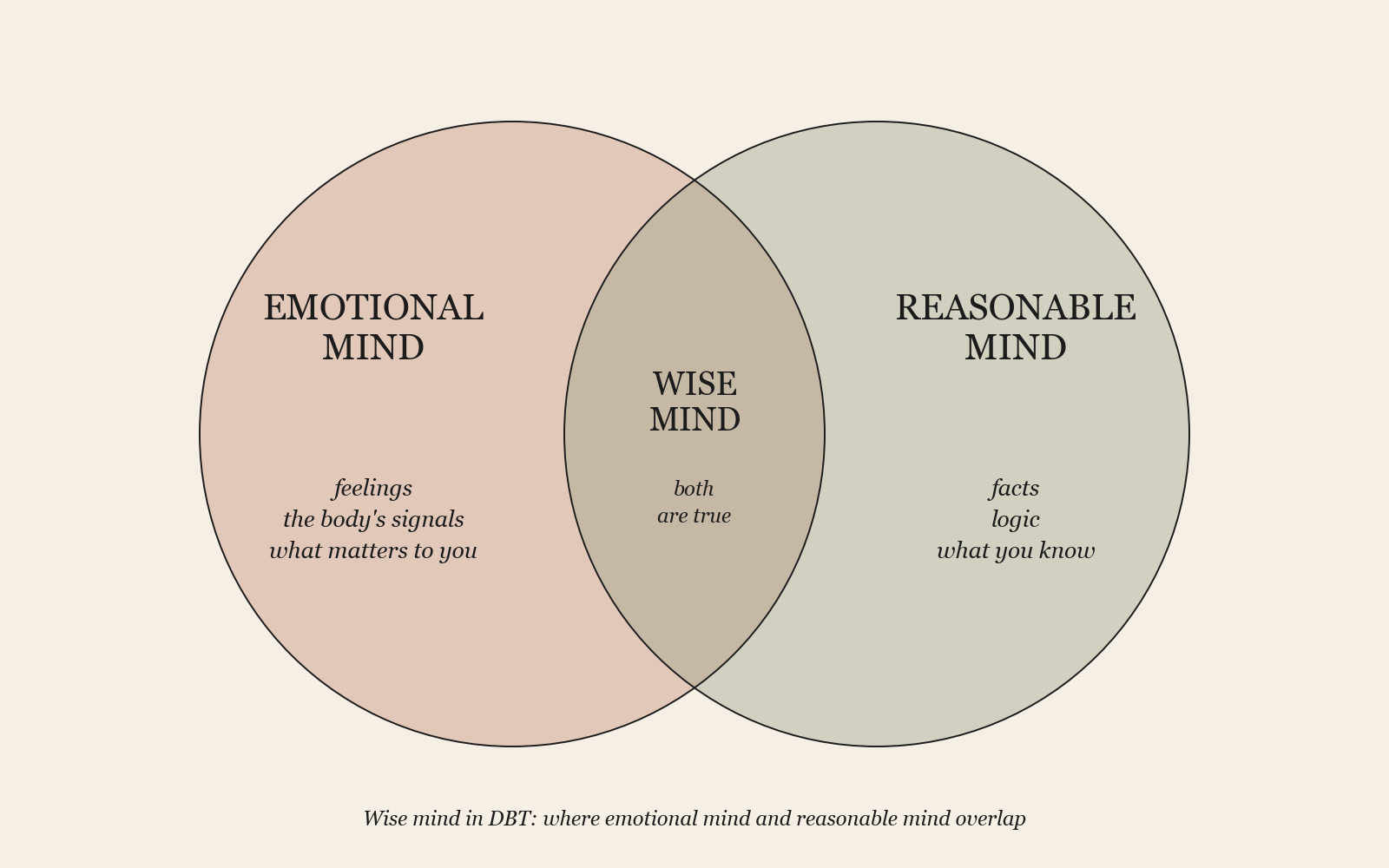
Emotional Mind
Emotional mind is when your feelings are steering. You notice the fear or anxiety in your body, and it tells you what's true: this is going to go wrong, I'm going to fail. Emotional mind isn't bad. It holds real information about what matters to you. But when it's the only voice, the worst case can feel like a certainty. People who catastrophize tend to spend a lot of time here.
Reasonable Mind
Reasonable mind, sometimes called logical mind, is when facts and analysis are steering. It's useful for planning and solving problems. But some people live mostly here and feel detached from their body and their emotions, which isn't the goal either. Pure logic can dismiss a feeling without ever hearing it.
Wise Mind
Wise mind is the overlap in the middle. It makes space for your fear and for the facts, so you can act with both in view. It usually feels grounding, not like a compromise where each side loses a little.
Where Wise Mind Fits in DBT
DBT skills are usually taught in four groups: mindfulness, distress tolerance, emotion regulation and interpersonal effectiveness. Wise mind belongs to the mindfulness group, which is the first one you learn, and the other DBT mindfulness skills build on it.
Mindfulness here doesn't mean emptying your mind. It means bringing awareness to two processes at once: what your body is experiencing, and what your mind is telling you about it. I wrote more about that in demystifying mindfulness.
Other DBT skills you may have heard of, like DEAR MAN for asking for what you need, or coping ahead for a hard moment you can see coming, work better once you can notice which state of mind you're in. That's why wise mind often comes first in DBT therapy.
A Wise Mind Example: The Test You're Afraid to Fail
This is the example I give my clients most often.
Say you've always had an insecurity about taking tests. Maybe it goes back to school, and now you're about to take one that feels important, like the SAT.
Your emotional mind notices the fear and anxiety in your body and says: I'm going to fail this test. I'm a failure. I'm never going to pass.
Your logical mind knows the facts: I've prepared for months. I studied well. I did okay on the practice exams. I did my best to get ready.
These two feel like they're in opposition, and there's a pressure inside that only one of them can be right. Either I listen to my body telling me I'm going to fail and mess up my future, or I listen to the part of me that knows the facts.
Wise mind invites the middle path. It might sound like this: "I feel really afraid of taking this test, and that fear is making me think I'm going to fail. I also prepared for months, and I'm going to do the best I can."
Notice what that statement doesn't do. It doesn't dismiss the fear, and it doesn't promise that everything will be fine. Things might still go wrong. Wise mind isn't blind faith. It's making space for both things to be true.
How to Practice Wise Mind: A Simple Worksheet
When I first do this wise mind exercise with clients, I have them literally write it out in bullet points. A notebook or a note on your phone works fine.
Name the situation. One sentence is enough: the test, the conversation with your boss, the text you haven't answered.
Write what lives in emotional mind. Every fear, feeling and worst case gets its own bullet. Don't argue with them yet.
Write what lives in reasonable mind. The facts: what you know, what you've done, what has happened before.
Write a wise mind statement. One or two sentences that hold both sides, often joined with "and" instead of "but."
Here's what that wise mind worksheet looks like for the test example.
| Emotional mind | Reasonable mind | Wise mind | |
|---|---|---|---|
| What it says | I'm going to fail. I'm a failure. This will mess up my future. | I've prepared for months. I did okay on the practice exams. | I feel really afraid, and I prepared well. I'm going to do the best I can. |
| Where it lives | The fear and anxiety in your body | The facts you know | Both at once |
| What it misses | The preparation you've done | The fear you're actually feeling | Nothing has to be dismissed |
The word "and" does a lot of work here. "I'm scared and I prepared" leaves room for both. "I'm scared, but I prepared" tends to cancel out the first half, and the fear usually comes right back.
You Don't Have to Do It in the Moment
I tell my clients this all the time: doing wise mind while you're freaking out is really hard. Sitting down to write bullet points in the middle of an anxiety spiral isn't always realistic, and that's okay.
Say you had an anxiety spiral after a conversation with your boss and couldn't do the exercise then. Try it the next day, when you feel a little calmer. The point is to bring intentional awareness to processes that usually happen without us noticing. With practice, it gets easier to find your wise mind sooner, sometimes even in the moment.
As with any new skill, start small. Practice on an everyday worry before you bring it to the situation that carries the most fear.
What Wise Mind Is Not
It isn't logic winning over feelings. Reasonable mind is not the "right" answer.
It isn't feelings winning over facts. Emotional mind is not the "real" truth either.
It isn't positive thinking. It doesn't tell you everything will be fine.
It isn't a test you pass or fail. Some days you'll find it easily, and some days you won't.
How Therapy Can Help You Find Your Wise Mind
In therapy, we practice wise mind with the situations that are actually happening in your life, and we notice together which state of mind you tend to go to first. If you grew up in a family where feelings were dismissed, or where emotions ran the house, one side may feel much more familiar than the other. Reading about emotionally immature parents can be a place to start if that rings true.
Identity and culture play a part, too. Many of my clients grew up with clear messages about which feelings were okay to show, and those messages belong in the room. I use DBT skills like wise mind alongside talk therapy, EMDR and sandplay, whatever fits you.
And there's room to celebrate here. The first time you catch yourself in emotional mind and find your way back to the middle is a real win.
Frequently Asked Questions
What Are the Three States of Mind in DBT?
Emotional mind, reasonable mind and wise mind. Emotional mind is led by feelings, reasonable mind by facts and logic, and wise mind is where the two overlap. You'll also see them called the DBT states of mind.
Is Wise Mind the Same as Intuition?
They're close. Many people describe wise mind as a sense of inner knowing that shows up once both emotion and reason have been heard. It's less a gut reaction and more a settled sense of what's true and what to do next.
Can I Practice DBT Wise Mind on My Own?
Yes. Wise mind is a useful skill on its own, and the worksheet above is a good place to start. Practicing it with a therapist helps when the same patterns keep coming back or when the feelings are very big.
What If I Can't Find My Wise Mind?
That's normal, especially at first or when emotions are high. Come back to it later, when you feel calmer. If you're in crisis or having thoughts of harming yourself, call or text 988 to reach the Suicide and Crisis Lifeline, or go to your nearest emergency room.
Who Is Wise Mind Helpful For?
Anyone who tends to get stuck on one side: people who catastrophize or feel swept up by emotion, and people who live mostly in their heads and feel cut off from what they feel. It often helps with anxiety, perfectionism and black-and-white thinking.
Reach Out When You're Ready
If you recognize yourself in emotional mind or reasonable mind, you don't have to pick one to trust. I see clients in person in Midtown Manhattan and online across New York. Book a free 15-minute consult and let's see if we're a fit.